
Understand What “Federal Arrests” Means
A federal arrest occurs when a person is taken into custody by a federal law enforcement agency for alleged violations of federal law. Federal agencies that conduct arrests include.
- Federal Bureau of Investigation (FBI)
- U.S. Marshals Service
- Drug Enforcement Administration (DEA)
- Bureau of Alcohol, Tobacco, Firearms and Explosives (ATF)
- Department of Homeland Security (DHS) agencies
Federal arrests are not tracked in the same systems as local or state arrests. They are processed through federal courts and detention facilities.
Search Federal Inmate Records (Bureau of Prisons)
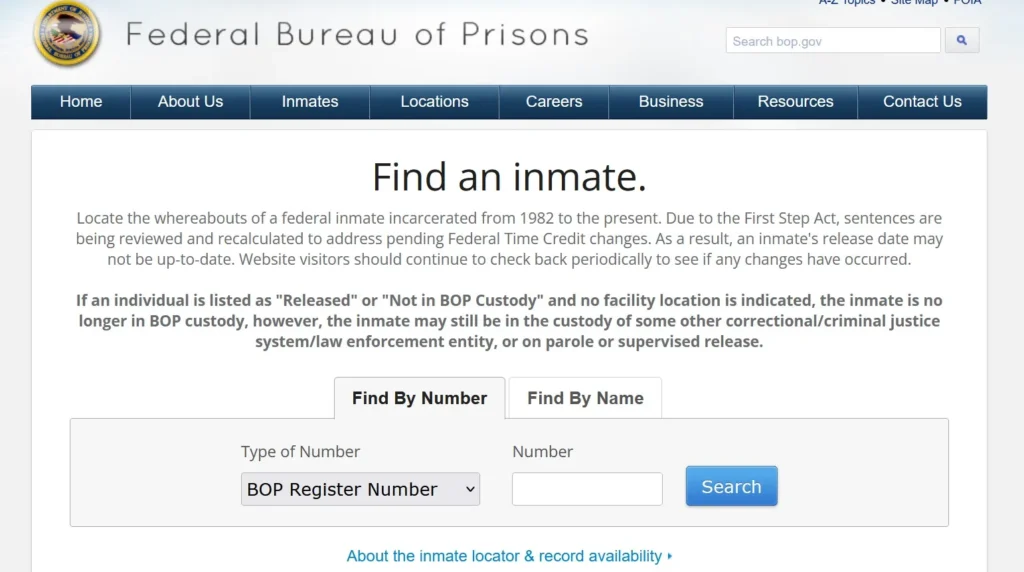
If a person is in federal prison, their incarceration information can be found using the Federal Bureau of Prisons Inmate Locator.
How to Use It?
- Visit the official Federal Bureau of Prisons locator:
https://www.bop.gov/inmateloc/ - You can choose the option Find By Number and Find By Name
- If you select Find By Number, You need “BOP Register Number”,”DCDC Number”, “FBI Number”,”INS Number”).
- Enter the inmate’s first, Middle and last name (full or partial).
- Enter RACE, Age and SEX.
- Review search results showing:
- Facility location
- Inmate register number
- Age at time of incarceration
- Click the inmate’s profile for additional details.
This is the official prison database for individuals serving sentences in federal facilities.
Search Federal Court Records (Arrest Charges Phase)
Federal arrest records are often connected to federal court cases. These records become part of the public docket once charges are filed.
How to Use PACER?
- Go to the official PACER system:
https://pacer.uscourts.gov/ - Create a PACER account (free to register, fees may apply for downloads).
- Search by name to find:
- Federal criminal case filings
- Arrest charge documents
- Court docket history
Federal arrests usually appear in a case’s docket once charges are formally filed.
Obtain FBI Identity History Summary (Optional)
The FBI’s Identity History Summary (rap sheet) provides a complete record of arrests processed at the federal and state level when legally requested.
How to Request?
- Visit the official FBI service page.
https://www.fbi.gov/how-we-can-help-you/need-an-fbi-service-or-more-information/identity-history-summary-checks - Follow instructions for submitting fingerprints.
- Request an Identity History Summary (rap sheet) for a complete arrest history.
Note: This service requires a formal request and fingerprints.
Check Federal Custody Status via VINELink
VINELink is an official custody notification network used by many states and federal agencies.
How to Use VINELink?
- Visit: https://www.vinelink.com/
- Select jurisdiction and search by name or ID.
- View custody status updates in near real time.
VINELink is widely recognized as a reliable custody tracking tool for re-entry and arrest notifications.
Understand What You Can (and Cannot) Find
Federally maintained arrest records and inmate data generally include:
- Arrest and charge documents filed in federal court
- Federal inmate custody status
- Facility location and release dates
- Court docket information
What federal systems do not typically provide publicly:
- Booking photos (federal photos are not released routinely)
- Arrest affidavits not filed in court
- Confidential investigative documents
- Sealed case records
Verify Through Official Government Sources Only
To ensure accuracy and avoid outdated or inaccurate data, always use official sources. Third-party websites may aggregate data but are not authoritative.
Official federal sources include below links
These sources are government-operated and updated regularly.
Understand Legal and Privacy Limitations
Federal systems respect privacy laws, meaning,
- Some information may be redacted
- Arrest summaries may not include arrest photos
- Custody data may only show incarceration status
Always respect legal use policies when accessing and sharing public record information.